Monday, 4 November 2013

It's an apple year

When we bought the house, we spotted the old fruit trees in the back garden - several neglected plums and a big apple tree, almost swamped by tamarisk.

Jerry under the apple tree
The Touraine Apple Munchers Association (les Croquers de pommes de Touraine) identified our apples as Reinette Blanche, an old variety suitable for both eating and cooking.  The ripe fruit is a lovely primrose yellow, sometimes flushed with pink, and with russet patches and/or nets of fine speckles. According to Orangepippin.com, it is also known as Reinette Blanche du Canada, Reinette du Canada and even just "Canada", and it is widely grown in France.

A windfall

Unfortunately, it's not a great keeper thanks to the birds and insects that constantly attack the fruit. No sprays, of course - even if we wanted to spray, the tree is next to the millstream and sprays are banned close to a watercourse (not that it stops the farmers mutter mutter....)

Last year, the year of no fruit, it bore nothing at all because an ill-timed frost wiped out the flowers here and in almost every orchard in the district. The tree is making up for it this year - the fruit are not overly numerous but they are extremely large, some specimens weighing over 350 grammes. Let's say 200 apples at 250 grammes apiece, about 50 kilos, that's a lot of compote. So far, only those apples receiving direct sunlight are ready to pick. One low-hanging fruit, sheltered by leaves and branches, is my barometer. I keep giving it the twist and flip treatment but it's holding on tight at the moment.

Low-hanging fruit

So far I have made and bottled mincemeat, three flavours of compote (plain, with grapefruit marmalade, and with honey), made cake, baked apples, eaten the things raw, grated with cereal, in slaw... Can't even give them away as everyone with an apple tree is doing the same. People seeing you approaching with a bag of apples tend to turn smartish in the opposite direction, or pretend not to be at home. One approach is to hang the bag from a door handle (house or car) and run for it. Could just work... bother, they spotted me!

Sunday, 3 November 2013

Apple whisky citrus mincemeat

A British Christmas wouldn't be the same without mince pies. Once upon a time these would actually have contained minced meat, with fruit and spices to disguise the fact that it was salted months earlier. Today mincemeat still contains suet, which is fat from around the kidneys of a cow (there is a vegetarian version, ptui). It is possible to buy fresh suet in France, which comes in lumps from the butcher (if he knows you he will keep some) for nuppence and can be grated. This is fine for a suet-crust pudding but I wouldn't like to use it for mincemeat.

Apple whisky citrus mincemeat ready for potting
Here's a recipe from Hilaire Walden's Sensational Preserves which combines a whole lot of lovely flavours. It needs at least six weeks to mature, so make it now in time for Christmas. These quantities yield five jars of standard jampot size, though where the pack size of the ingredient meant that there was only a little left, I lobbed the lot in. And of course I used our own filberts and apples.

At the beginning...Reinettes blanches
Ingredients
550g/1¼lb cooking apples, peeled, cored and chopped
15g/½oz unsalted butter
4 tablespoons water
85g/3oz almonds, blanched and chopped
85g/3oz hazelnuts, blanched and chopped
115g/4oz currants
115g/4oz cut mixed peel (aiguilles de citron /d'orange, chopped)
115/4oz dried apricots, chopped
225g/8oz raisins (I used jumbo golden raisins, which are gorgeous)
225g/8oz sultanas
115g/4oz suet
225g/8oz dark muscovado sugar
Grated zest and juice of 1 lemon
Grated zest and juice of 1 orange
1 teaspoon ground cinnamon
½ teaspoon ground ginger
½ teaspoon freshly grated nutmeg
A pinch of nutmeg
150ml/5 fl oz whisky

Method
Put the apples in a pan with the water and butter. Cook gently with the lid on for 20 minutes then stir to make sure there are no lumps. If the resulting purée is runny (i.e. you've used Bramleys), turn up the heat and cook, stirring all the time, until the mixture is quite stiff and all free liquid is gone. Allow to cool completely.

Mix all the other ingredients together in a large non-metallic bowl then stir in the apples. Mix until thoroughly blended and leave, covered of course, overnight.  At this stage, a gadget! The lid of this plastic bowl projects over the lip, sealing it completely. Thanks again LIDL!

Not that terrifying, surely?
Pack into clean dry jars, ramming down well to avoid air bubbles, and seal in the usual way. Store for at least six weeks before using.
What's the post called again?
Serve as a dessert with poached orange slices, or in pastries.

Saturday, 12 October 2013

Nuts in May

Here we go gathering nuts in May?  I wouldn't think that's a particularly good time of the year to guarantee success, in the Northern Hemisphere at least! Yet another highly suspect nursery rhyme.

The recipe, for Apple Cake in a Nutshell as blogged about by Jean in Baking in Franglais, required four ounces of blanched hazelnuts. We have filberts, fresh from the tree. This calls for - a gadget!

What is it?

My dad's wonderful nutcracker, with its tiny ship's wheel that you wind to extend the clamp as gently as you please, guaranteeing an undamaged kernel. Four ounces is quite a lot of cracking, even with giant filberts, so that was an evening's entertainment.

Cracking a filbert with precision
Now blanching - the method I learned for almonds - three minutes in boiling water - just didn't work. After five minutes futile scraping I gave up. The internet came up with the addition of baking soda (Bicarb) to the water in the proportion of three tablespoons to two US quarts. I used two teaspoons to a UK pint, again boiling for three minutes, then rinsed them in cold water. The method then said to rub the skins off in a teatowel. I'm sure that would work, particularly with more than my four ounces, but having seen the rich pink colour the water had turned, the subsequent cleaning of the teatowel struck me as a problem. So I rubbed the skins off with my fingers, dipping occasionally in a finger bowl. Success! Clean as a whistle. Not so clean Tim's hankie with which he experimented on the liquid as a dye.

Going...
Almost gone....
 Finally, how to coarsely chop them... the blender just chipped a few bits off them... we gave away our hachoir because we never used it... drat... Tim chopped them with a ceramic-bladed knife. Somewhere no more than a mile from here, a prehistoric woman or man did the same thing, with a flint blade like the ones we dig up in the potager. I don't suppose they bothered skinning them. Sometimes the old ways are the best.

The finished cake - cooked for 20 minutes longer than the recipe said, with foil on top

Monday, 7 October 2013

Beans, beans, good for the heart

Sunday was a gloriously sunny autumn day - a fine day for harvesting! We were greeted by the vanguard of our winter visitors - the lapwings, flying overhead. First a couple of trays of "Reinette Blanche" apples from our venerable tree - many almost too big to fit in the bag of the apple picker, and unfortunately many damaged by sharp little beaks. More compote de pommes (stewed apple) coming up, I expect! This is a prime opportunity to try different flavourings and sweetenings - the first batch was straight apple and a little sugar, the second batch apple and honey, for the third there's some grapefruit marmalade that didn't set...

Next, on to the beans! We grow most of our beans from our own saved seed for winter use, in soups, cassoulets, chilis etc. This means they have to be bone dry when they go into their storage jars. Due to the late spring, they were planted late and have only just begun to get that papery texture in the pods that tells us they are ready. The bean frame is presently flaming with Borlotti "Lingua di Fuoco" (fire tongue) climbing beans, just starting to turn the dull red and then indigo of the fully ripe bean.

The bean frame, an idea copied from Majorca

Firetongue

Borlottis with Nun's Belly Button below (naturally)

Surrounding the base of the bean frame, Tim planted a load of another favourite - the dwarf bean "Nun's belly button". The French name is "nombril de bonne soeur" - an exact translation, although the same bean is known in French as "Saint Esprit" and in English as "Soldier".


Nun's Belly Button beans
William Skyvington, an Australian expatriate in France, has blogged about them here, although as his post is dated April 1, I'm unsure how much of his tale is a leg-pull. Be that as it may, I see the nun, or the part of her visible, as definitely a redhead, and very hairy.

Whereas Tim sees the whole nun, the other way up. That's the soldier, an English redcoat.

Spot the nun (or soldier)
Spot the soldier (or nun)

In the immortal words of my old friend Liam D'Arcy Brown (no, not the Sinologist, the other one),
Beans, beans, good for the heart,
Beans, beans, they make you f*rt,
The more you f*rt, the better you feel,
Beans, beans, with every meal!

Monday, 30 September 2013

Just a few pumpkins then...


Sunday 29th... Meteo60 promised us rain all day, more or less heavy.
After a dry, fairly overcast but not unpleasant morning with Pauline stringing onions in the hangar while Tim submitted the freezer to a long overdue triage and turned the results into a vast curry, a sudden decision was made to harvest the pumpkins.

Our method of growing pumpkins developed by accident on our allotment, when a long strip of ground that had held raspberries became overgrown. We cut down the growth and laid it along the strip, covering it with black polythene to help it rot down and prevent regrowth. Tim then added all the raked up strimmings from the three allotments we had [one was only fruit!]. Come next June we cut holes in the polythene to find a good layer of compost in which we planted the pumpkins - and other members of the family cucurbitae such as courgettes. They grew like billy-oh and produced a wonderful harvest. The polythene absorbs the sun's heat and keeps the roots warm, suppressing weeds at the same time. We learned quickly that we needed to mark the position of the planting holes with canes so we could water in the right place.

The 2012 "maggot" being planted up...
tomatoes were planted at the top end [through polythene]...
you can see the polythene and rocks at top left.
The pile of dry grass is to cover the maggot once planted.

This system has evolved into "the maggot", which is built during the summer mainly from mowings out of the orchard and potager areas. This is covered in spring with three large tarpaulins roped together and pinned down with rocks. The tarpaulins have hatches cut in them where the plants go. At planting time the holes are filled with a mixture of compost and sieved soil, dosed with pelleted chicken manure then in goes the plant, with a cane to mark its place. The tarpaulin is then covered in further mowings to protect it from the sun and to give the fruit something to rest on.


The "Maggot" about a month ago [August 25th]

Pumpkins need room to grow... the maggot is 14 metres by 3 metres...
the pale leaves near the top end are the Red Kuri...
it has sent one runner down as far as the Yellow Crookneck...

and back up as far as the melons which are right at the far end...
a total length of around 20 metres!
The Crown Prince [the large dark leaves at the top end]...
has completely covered the nine square metre area between the Red Kuri and the Melons...
and had to be guided back on to the maggot almost daily!!

Viewed from the "Melon End"... the gap between the Crown Prince and the melons closed within a week.
The maggot base for next year is visible to the right...  all the dead cucurbit plants, the hay over the tarps...
and anything still uncomposted under the current maggot will be added to next years!
This year's empty maggot bed will become 2014's Spud & Tomato bed.


This year the plantings were:
     Grown from seed:
Pumpkin [potiron] Crown Prince: 1 plant
Butternut Harrier: 3
Butternut Hunter: 3
Cucumber Diva: 1
Cucumber Marketmore: 1
Courgette Rond de Nice: 1
Squash Yellow Crookneck: 3 (one died)
     Bought in:
Red onion [pottimarron] squash Uchiki Kuri: 1 plant
Courgette Iceball: 1
Melon Cézanne :2 [in one pot]
Melon Troubadour: 2 [in one pot]
Pumpkin Blue Ballet: 1 (died)
Patidou: 1 (nearly died)
We have been harvesting cucumbers, courgettes and crooknecks all summer, and blogged about them here and here. Iceball is an excellent courgette, very like Rond de Nice but paler, earlier and more productive. The melons didn't really get going until late August, Troubadour being earlier, richer in flavour and producing more fruit.

The Patidou struggled but survived to produce two fruit, still immature so we left them a little longer. I am now certain Patidous are what I have tried growing in the past without much success: Sweet Dumpling. It has a creamy skin with dark green stripes - very attractive.

Sweet Dumpling... the dark green stripes turn a rich orange when fully mature.
[Note the fertile baby Hunter butternut at the bottom left!!]
The Crown Prince excelled itself, producing no less than 8 fruits with a combined weight just over 28 kilos. The root looked like the claw of a monstrous bird, possibly a roc.

It really had its claw in!
There was some speculation over what would have resulted had we restricted the plant to one fruit - a pumpkin we couldn't lift?

The Red Kuri produced almost as big a plant, but only three fruit, averaging at a kilo and a half. The fruits are indeed onion-shaped, deep orange flecked with cream. This Japanese derivative of the French potimarron is not a keeper, but has a rich chestnutty flavour. When we have grown it before, it was the earliest to ripen, but not this one. [Small ones work wonderfully for individual Hoofearnlywhittingstall Pumpkin Soup]

The first barrow load....
all the Red Kuris, the biggest Crown Prince...
and the split butternuts [mainly Harriers]


The other seven Crown Princes

The second barrow with the other Butternuts... mainly Hunter.

So far we have harvested 16 fruits from each of the two varieties of Butternut squash, a total of 27 kilos in weight. Hunter and Harrier are part of a series developed for growing in British conditions and named after military aircraft  (yes, Hawk and Hercules as well). There is no difference that I can discern between the two varieties, neither in appearance, size, flavour or keeping quality. However the Hunters have gone bonkers and produced a second flush of fruits which are swelling nicely - normally, late fruits get rejected and rot off. It's as though the plants have decided that their first flush is ripe and they have time and energy to have another go.
You might guess that we love Butternut squash!


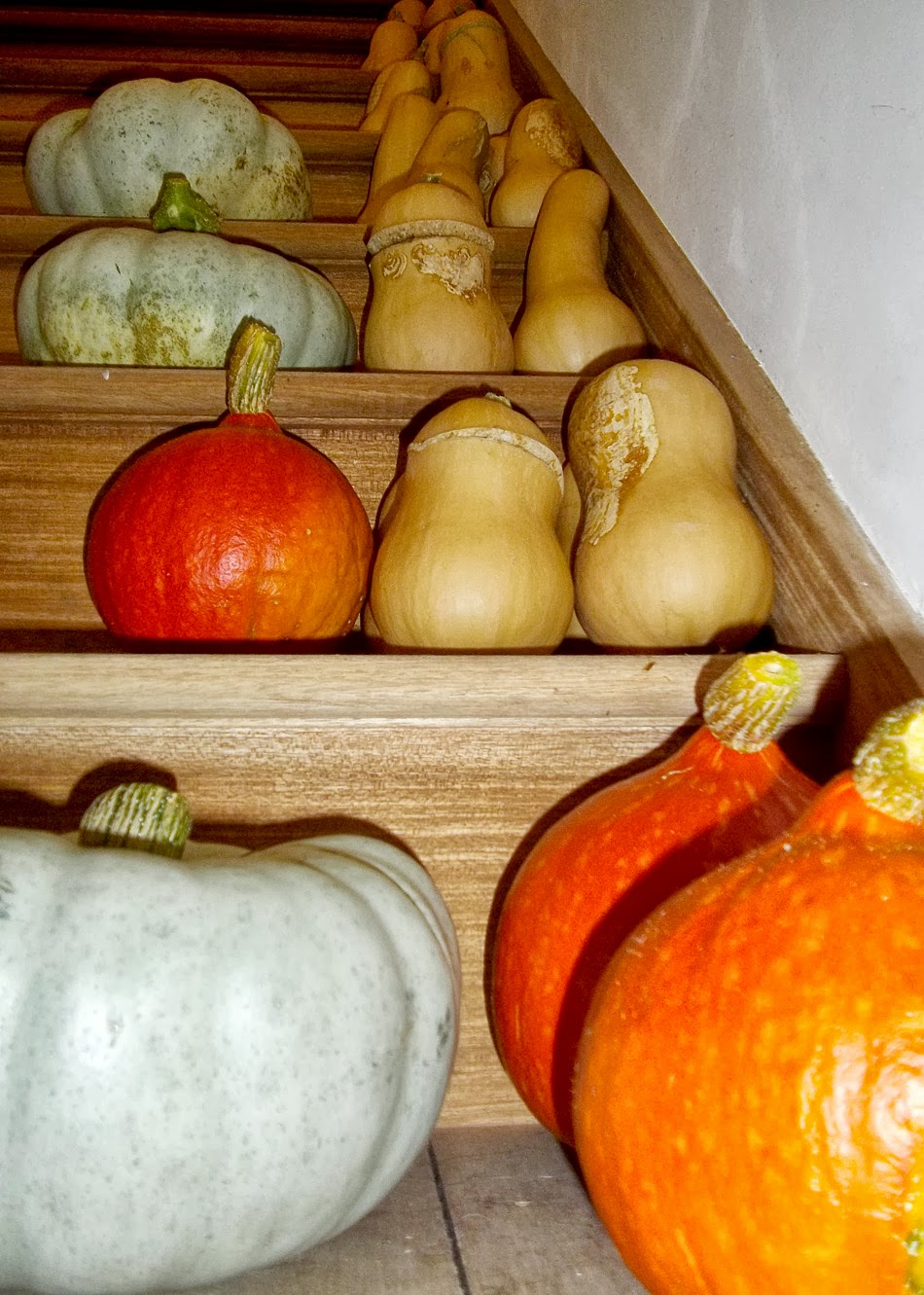
So... now we have a stairwell full of pumpkins!!
AGAIN!!!