Showing posts with label Pumpkin. Show all posts

Friday, 16 October 2015

Naked upon a pumpkin

The morning of October 13th brought with it a sharp frost that cut down our pumpkin, courgette and cucumber plants into a mushy confusion of twisted stems and disintegrating leaves, with here and there a fruit showing through. Since then the temperature has stayed at wintery levels, although without an actual frost. Time to gather in the squashes.

The squash bed ("the Maggot"), 28th September 2015
In past years we have blogged about our favourite pumpkins, e.g. see here. Needless to say we grew them again.

This year's top statistics:
  • 10 Crown Prince pumpkins at a total weight of 31.442 kg. Additionally there are two immature ones weighing just over 1kg each, which may not come to anything
  • 12 Butternut squashes totalling 7.135 kg. The two small ones are earmarked for a squash fan for her own personal consumption!
  • 2 Sweet Dumpling a.k.a. Patidou at 1.137kg plus one we have already eaten 
  • 2 Sweet Dumpling / Butternut hybrids and a strange yellow thing (Yellow Crookneck cross Butternut?) that germinated on the compost heap.
Mainly out of curiosity, we grew a couple of pumpkins for edible seed this year. The pumpkin seeds that are on sale as healthy snacks aren't milled or in any way treated to remove a hard seed coat. The varieties of pumpkin that give pumpkin seeds just don't have a seed coat to speak of. They are called "Naked Seed Pumpkins". The only readily available variety is called "Godiva" (snigger). But wait! Surely there is an excellent source of seeds. Your local supermarket sells the stuff by the ton, 250gm at a time! In April I took a couple from a Bio Coop packet, making sure they were undamaged. The small print identified the variety as Styriaca, and they came from the Ukraine. They germinated readily, and grew into compact plants. Each bore one fruit.

Styriaca pumpkin, 28th September
By 12th October one fruit was ripe, almost entirely orange and ready to pick.

Ready for dissection
And here is the result.

Fresh pumpkin seeds

From the weight and the price of a 250gm pack, we calculated the value at 83 centimes. They are much juicier than shop-bought seeds, though. They will be put through the food drier for half an hour or so.

Our allotmenting colleague Steve Shillitoe, from whom we learned of this ploy, reckons that the fruit is edible too, so we'll give it a try.

Sunday, 1 March 2015

Cheesy pumpkin muffins

Herewith another of the trio of recipes "cuisine express" by Flavie Degrave that I found in a magazine, the name of which I no longer recall, in the physotherapists' waiting room. Muffins with Beaufort cheese and red onion squash - simple enough store-cupboard ingredients, we have a couple of potimarrons left and several cheeses in the fridge, "certainly what it takes to make [this recipe]".

The original recipe - muffins with beaufort cheese and red onion squash
So here's cheesy pumpkin muffins.

Shared between twelve cases, they look tasty but rather miserly
  • I substituted St Nectaire, which we had lots of in the freezer, for the Beaufort which is 22 euros a kilo on promo. Both are a "cooked" cheese with a soft but firm texture and a distinctive flavour. Both have AOP status (several paragraphs deleted here burbling on about "patrimoine" and "terroir", both untranslatable unless you are allowed to include a 12-page essay).
  • The recipe says "half a potimarron". Now that's a moveable feast: a potimarron (a.k.a. Red Onion /  Red Kuri / Uchiki Kuri squash) can easily weigh a kilo and a half. I used a small butternut squash which yielded 300 grammes prepared weight of pumpkin flesh and it was too much. No more than 250g, let's say 200g.
  • I split the mixture between 12 muffin cases. The muffins did not rise much, with so much pumpkin to flour, and they looked lost in the paper cases, to which they stuck firmly. The recipe makes six standard muffins and I recommend using silicon moulds rather than paper cases. 
  • I had no fresh chives, so I used a sprinkling of dried lovage; dried thyme could add an interesting dimension. 
  • I added a pinch of cayenne. Naughty, but nice.
  • Most of the time was taken up with the chopping. Once it was all done, the recipe is a doddle. 
  • After the recommended cooking time of 25 minutes using a fan-assisted oven the muffins were not done and I gave them another 10 minutes. They really needed a bit longer - I'd say don't use fan assist to avoid burning the top. It will take longer to cook the same mixture divided into six instead of twelve, but the removal of the paper case will speed things up ... the square on the hypotenuse ... windage ... let g be the acceleration due to gravity... oh, give it another ten minutes and poke one with a skewer!
Next time I'll do this mix as six muffins

Muffins with Beaufort / St Nectaire cheese and red onion squash

Ingredients
200g peeled potimarron, butternut or Crown Prince squash, cut into small dice
80g Beaufort or St Nectaire cheese, cut into small dice
10 leaves chives, rinsed and snipped into short lengths
1 clove of garlic, peeled and finely chopped
50 g onion, peeled and finely chopped
2 eggs
110g plain flour
1 teaspoon baking powder
65ml olive/sunflower oil
50ml milk
Nutmeg
Freshly ground pepper
A pinch of salt

Method
Soften the onion and garlic in a tablespoon (15 ml) of the oil for 3 minutes. Stir in the pumpkin, sprinkle with pepper, put on the lid and let it cook for 5 minutes. Add the chives or other herbs of your choice, stir and allow the mixture to cool (immerse the bottom of the pan in cold water if necessary).. Meanwhile, lay out six silicone muffin moulds on a baking sheet, or line 6 muffin moulds with greaseproof paper or muffin cases.

Heat the oven to 180°C. Beat the eggs. Putting the pumpkin and the cheese to one side for a minute, mix the remaining wet ingredients in one bowl and the dry ingredients in another. Add the dry ingredients to the wet ingredients and give a good stir, but don't overmix or your muffin will be hard on the outside. Add the pumpkin, then the cheese. Share out the mixture between the muffin cases. Cook for 25-40 minutes until done.

Serve at room temperature.

Very tasty, very very tasty ....
And the last recipe - brouillade d'oeufs aux cèpes (scrambled eggs with ceps / bolete mushrooms) - is exactly what it says on the tin. Or in my case, jar.

Wednesday, 11 February 2015

Pumpkin Conserve - a serving suggestion

Back in December 2011 we posted about a particularly delicious and easy Conserve made from Pumpkin, lemons, sugar and butter.
This week I made some more.

You can just eat it out of the jar with a spoon!
From comments we received, we thought people might be unsure how to serve it.

Take some digestives, some cream cheese and some Pumpkin preserve...
Tim's favourite is an instant Pumpkin Cheesecake, made with a digestive biscuit, a creamy cheese and a dollop of Pumpkin conserve.

And serve.
Delicious!


Tuesday, 2 September 2014

So what is the "maggot"?

The "maggot" was invented in the 2007 growing season on our allotment plot in Leeds. The previous summer, a row of raspberry plants reached the end of its working life. We were faced with a ten yard by one yard* area of couch grass, dandelions and old raspberry canes. Allotment associations have rules about weeds. Not having a great deal of time to spend weeding this strip, we covered it in heavy-duty black polythene and used it as a dump compost heap for grass clippings and other compostables. It was left for the requisite two seasons, with the addition of further layers of compostables, and then we lifted the polythene. Underneath, the annual weeds were gone, and the couch roots readily pulled out of the moist earth. We piled the decayed compost onto this surface and put the black polythene back to stop the weeds from taking hold again before we had worked out what to do with this new piece of ground.

The name "the maggot" came about from the shape formed by the wheelbarrow-loads of grass trimings and weeds, which created a series of mounds like a big green caterpillar. When Tim felt the heat radiating out of the long black cushion-like area that resulted, it seemed an ideal place to grow squashes and pumpkins. The black covering would keep the roots warm and retain moisture, the decaying vegetation would generate heat and nutrients, the living foliage would disguise the black polythene. We cut holes in the polythene, parted the compost to reach the soil surface, dug some pelleted chicken manure into the ground, added some general purpose compost, planted just four plants (Acorn squash, Crown Prince, Red Kuri, butternut Harrier...).
The pumpkins loved it. They grew phenomenally, and covered the black polythene completely. We quickly learned that we needed to mark the planting holes with canes, so that we could tell where to direct water and feed, so well hidden they were by leaves. The crop was excellent. We repeated the exercise the following year, in the same place, with equal success.

In France, the maggot system is used for all our cucurbitaceae - courgettes, cucumbers and melons as well as squashes and pumpkins. Every year it hs been refined slightly.In 2011 we replaced 2/3rds of the black polythene with tarpaulins (bâches), cutting the planting holes with a soldering iron to seal the edges. Last year we bought a third, which has two holes in for the pumpkins. Now there is a drip watering system, and we have retired the marker canes.
However, next year the canes will go back, to mark the plants for feeding, but we can't see the holes. We can't find them in the foliage!
A jetwash-type dispenser attaches to the ordinary hose for the feeds.

 
The maggot 2014 showing planting windows and scientific method of holding it down.

We use the maggot as a way of breaking in new land. We cycle our plantings through a series of five sets of beds. The 2014 maggot completes the cycle. Next year it moves to bed Number Two and will, hopefully, start to really condition the soil by adding all that composted vegetation to the soil for the start of 2016.
The pale green bâche in the background covers a stock of dry grass clippings that should have gone onto the maggot before the plants got too large. Unfortunately, the plants grew so quickly this year, we missed the opportunity, so it will be added to next year's "maggot".Or used to put around plants that need protection over the winter, then added to the compost cycle.

19/5/2014 Maggot ready for planting, the potato beds (site of 2013 maggot), leeks and onions (maggot 2012).
The planting windows are filled with a mixture of soil (originally molehills), fumier (bagged horse/cattle manure) and multipurpose compost, with added pelleted chicken manure and hoof and horn (corne broyée). The ground underneath is loosened with a fork so the roots can penetrate more easily. We raise our young plants in propagators in the guest room. They are moved into pots in a cold frame, and we plant them after the Ice Saints indicate the last frost is past.

25/07/2014 Growing strongly
Near row: from left, melons, Crown Prince, Sweet Dumpling (patidou), Red Kuri (potimarron), butternuts Harrier and Hunter, cucumber La Diva. Far row: Golden Nugget, courgette Rond de Nice, two plants each courgettes Précoce Maraichère and Ice Ball, Yellow Crookneck squash, cucumber Marketmore, another Yellow Crookneck.

25/7/2014 view from the Melon Patch showing the drip watering system
The dry grass is to lift the growing fruit away from the tarpaulin, which can collect rainwater in puddles.

30/08/2014 a breaking wave of vegetation - Sweet Dumpling heading to take over the melon patch
By the end of August the tarpaulins are completely covered and the vines are heading over the grass. The plants on the side near the wheelbarrow have put on so much greenery that we suspect there may be organic remains underneath dating back to the dairying days of our land. We may find out more next year when it comes to potato planting season.

The maggot, with Bezuard farm in the background

A hint of fruits to come:

Crown Prince

Red Kuri

Another Red Kuri, with a Butternut behind it

Sweet Dumpling / Patidou

* when Burley Model Allotments were established in 1958 on a site that was designated originally for allotments in 1892, a standard plot was 10 yards wide by 30 yards deep, an area, my dad used to say, of "one perch". A square perch is actually 30 ¼ square yards. No doubt the plot size is now 9.144 metres by 27.432 metres. No amount of metrication will make the plots any bigger or smaller.

Tuesday, 10 December 2013

Little Golden Apples

One of the highlights of the Tournon St Pierre "Foire aux Arbres" on 24th November each year is a stall run by the local Lions Club, selling nothing but Leonidas chocolates and home-grown pumpkins, in aid of children's health charities. This year we noticed a bucket of tennis-ball sized yellow things, and we asked what they were."Pommes d'or", explained the stall holder. "Délicieuses!"

Ever fools for an unknown pumpkin, we picked out a matching pair, and handed over a euro.

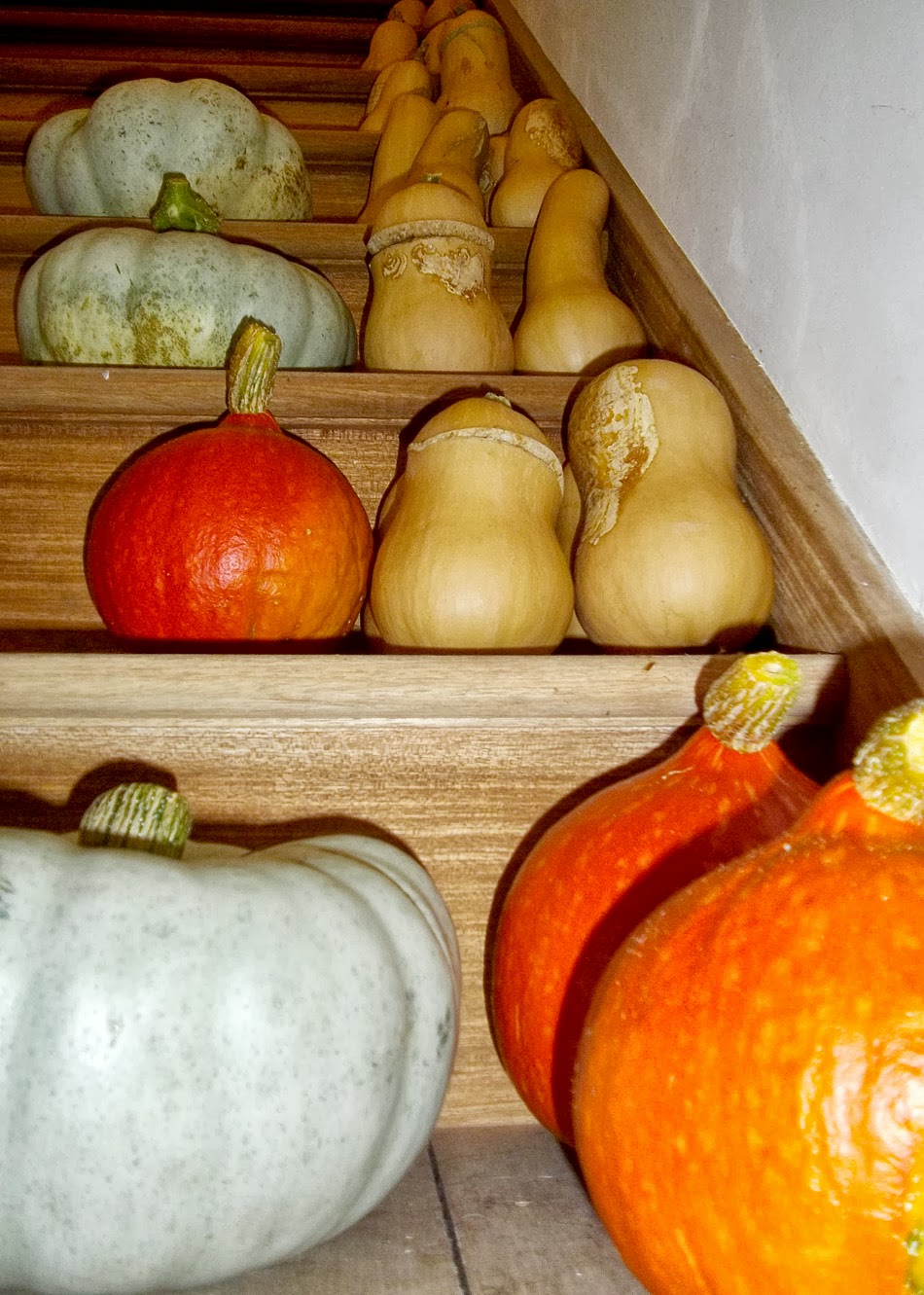
For a fortnight they sat on the stairs with the Crown Princes.

Two yellow hand grenades
Last Friday night we ate them - rather too rapidly to take any pictures! That golden skin proved to be rather tougher than Kevlar™ - don't try to peel one - and it took me five minutes to cut around the stalks, at grave risk to my fingers, to make hats so that we could stuff them. I scraped out the seeds to reveal stringy-looking flesh, perhaps a centimetre thick, or a bit less. Unpromising. But it smelt good.

We pre-cooked the squashes in a lidded Pyrex casserole in the microwave for 10 minutes with a little water inside and out, while Tim made a stuffing of leftover pot-roast beef, onion and celeriac. Then we stuffed and baked them for half an hour, and served them with Pink Fir Apple potatoes and chard.

They were, indeed, delicious - incredibly rich, sweet, creamy flesh with flavours of honey and chestnut. We scraped out the last of the flesh with teaspoons, The skins have gone even harder, leaving a solid cup which looks as though it is made of bakelite.  Later I found the recommended approach to be roasting them whole until soft(er) then cutting, or you could puncture them with a barbecue skewer or hammer drill and microwave them whole likewise. Other Pomme d'Or fanatics describe the skin variously as
"wickedly hard...like cut your finger off if you try to slice it hard"
"The Hardest Substance Known to Man".
They are perfect for sound effects of horses' hooves

I found several recipes specifically for Pomme d'Or on the web, logged by people who had much the same experience as me: struggle, followed by doubt, then inspiration and finally exaltation. In the recipe here the Pommes d'Or are halved (after pre-cooking) and filled with a risotto of wild mushrooms. I think they would be good with a cheesy filling, like this one. Tim suggests filling them with Spiced Pumpkin Icecream and freezing them, to serve up for special guests. For a main course, you need to allow two Pommes d'Or per head; one apiece for a starter or dessert.

Sunlight through squash skin

But that would mean getting a whole lot more. A little research informed me that all the seeds available commercially originate in France and are AB (organic). Germinance claim to sell their seeds at The All-Green Pea, but no, the Bio Co-op doesn't sell seeds, at this time of year at least. An alternative is to buy on-line from Germinance, from Ferme St Marthe or their partner the Organic Gardening Catalogue in the UK.

Apparently Pomme d'Or plants are gallopers capable of producing 20 hand grenades each. No wonder they were on sale by the bucket full! They can be grown as a climber - they won't like it, though.

Saturday, 7 December 2013

Tail of a spoon

Having made a series of fruit cakes, I thought it was time for a change. Since we have a squad of squash and a plethora of pumpkins, I looked up a favourite recipe for pumpkin tea bread - a fine squidgy accompaniment for morning coffee or afternoon tea. My version uses a half pint of pumpkin purée, so I attacked a large butternut squash with - a gadget! It's the ideal tool for removing the seeds from a squash or a melon, and it's the only one in the world.

A keen edge

Every day, my parents made one or other of the great (nay, the only) British sauces - gravy and custard. Both require lots of stirring to incorporate a powder into a liquid - flour into stock in the case of gravy, custard powder into milk for the sort of custard my parents made. They always used the same saucepan and spoon. Over the course of fifty years, abrasion wore away the tip of the bowl, leaving a half-moon shaped curved edge as sharp as a razor. It's a perfect fit to the seed pocket of a squash. Thinks: the eroding metal must have been swallowed...

A speedy exit for the squash seeds

On the back of the spoon handle there are two stamps. one says "P.A&S" with a shield bearing a mailed arm holding a pennant; the other says "ASHBERRY".


Mark of Philip Ashberry and Sons, Sheffield.

The spoon is made of EPNS - electro plated nickel silver

These marks indicate that the spoon was made by Philip Ashberry and Sons of Sheffield, now part of the Spear and Jackson group. The P.A&S stamp was used by Ashberry between 1880 and 1935. My Dad would have been 15 years old in 1935. He and Mum were married in 1948 and started married life with a new set of Viners EPNS cutlery. Knowing my Dad, he never wasted anything. Of course he'd use an old spoon to make the gravy! And I used one of the Viners forks to mash the steamed squash. So it goes...

Many thanks to Giorgio B. for this information from his web page BRITISH ELECTROPLATE SILVER AND SILVER PLATE MARKS, which is just one of 1000 pages of A Small Collection of Antique Silver and Objects of vertu, an extremely modest title for an enormous work of detailed research.

Tuesday, 26 November 2013

Crown Prince becoming a Rarity

The last of 2012's Crown Prince, unblemished and still perfectly edible, became Spiced Pumpkin Ice Cream at the end of October, 13 months after it was picked! See below for the recipe.

Banana Split with Spiced Pumpkin Ice Cream, Crème Crue and Marrons Glacées
The harvest at the end of September stimulated the Uchiki Kuri and the Butternuts into further action! The incredibly late autumn meant that we had to balance the fact that the fruit were still swelling against the preparedness of the slugs and snails to attack them.

The additions bring Uchiki Kuri to seven fruits averaging just over a kilo, and the two varieties of Butternut to 22 fruits apiece, averaging 750 grammes (Harrier) and 830 grammes (Hunter). Harrier's batting average was distorted by the last two fruit, at 182 grammes apiece. The plants averaged seven fruits each, which is not bad at all. We have a total of 71 kilos of pumpkin and winter squash, 61 fruits altogether.

From the top - Uchiki Kuri, Sweet Dumpling, Crown Prince and Pomme d'Or from Tournon Fête aux Arbres

Some of my 2014 seed order has come from the Organic Gardening Catalogue. As a member of Garden Organic I get a 10% discount on my purchases. The bad news is that their advertised Crown Prince is actually a different F1 hybrid variety called Rarity. Some web searching indicates that Rarity produces smaller fruit (2 kilos instead of 3 to 4 - good) but that doesn't have so much flavour (bad). Compare the rounded smooth squashes in the picture below with the male flowers at top right to get an idea of the size, and with the lumpy, flattened, much bigger beasties on the stairs.

Rarity (the only picture I can find)
The OGC told me that their supplier maintained that Rarity is the same as Crown Prince, which clearly it isn't, though whether it is an improvement or not remains to be seen. They are reimbursing me, and I have ordered a replacement from King's Seeds (after telephoning them to make sure I wouldn't get Rarity again).

Spiced Pumpkin Ice cream
from Ices - the definitive guide by Caroline Liddell and Robin Weir
Ingredients
375ml / 12 fl oz milk
3 egg yolks
200g / 7 oz light brown sugar
½ tsp vanilla extract
pinch ground cloves
½ tsp ground ginger
¼ tsp ground nutmeg
¼ tsp ground pepper
250 ml / 8 fl oz thick pumpkin purée e.g steamed Crown Prince or Butternut
185ml / 6 fl oz whipping cream
2 tsp brandy
Makes about 1 litre / 32 fl oz.

Method
Make a custard with the milk, egg yolks, sugar and spices, by your favourite method - for example see here. 
Allow the custard to cool completely, stirring occasionally.
Beat in the pumpkin puree and the cream. Add the brandy, taste and add more spice if preferred.
Cover and chill it in the fridge. It can be left overnight at this stage, if necessary. Pass the mixture through a sieve to remove odd lumpy bits of pumpkin (if you’re fussy).
If using an ice cream maker, set it going and pour in the pumpkin mixture. Freeze to the consistency of softly whipped cream. Scrape into plastic boxes, cover with greaseproof or waxed paper and a lid, label and freeze.
If you don’t have an ice cream maker, follow the standard ‘still freezing’ technique.

Monday, 30 September 2013

Just a few pumpkins then...


Sunday 29th... Meteo60 promised us rain all day, more or less heavy.
After a dry, fairly overcast but not unpleasant morning with Pauline stringing onions in the hangar while Tim submitted the freezer to a long overdue triage and turned the results into a vast curry, a sudden decision was made to harvest the pumpkins.

Our method of growing pumpkins developed by accident on our allotment, when a long strip of ground that had held raspberries became overgrown. We cut down the growth and laid it along the strip, covering it with black polythene to help it rot down and prevent regrowth. Tim then added all the raked up strimmings from the three allotments we had [one was only fruit!]. Come next June we cut holes in the polythene to find a good layer of compost in which we planted the pumpkins - and other members of the family cucurbitae such as courgettes. They grew like billy-oh and produced a wonderful harvest. The polythene absorbs the sun's heat and keeps the roots warm, suppressing weeds at the same time. We learned quickly that we needed to mark the position of the planting holes with canes so we could water in the right place.

The 2012 "maggot" being planted up...
tomatoes were planted at the top end [through polythene]...
you can see the polythene and rocks at top left.
The pile of dry grass is to cover the maggot once planted.

This system has evolved into "the maggot", which is built during the summer mainly from mowings out of the orchard and potager areas. This is covered in spring with three large tarpaulins roped together and pinned down with rocks. The tarpaulins have hatches cut in them where the plants go. At planting time the holes are filled with a mixture of compost and sieved soil, dosed with pelleted chicken manure then in goes the plant, with a cane to mark its place. The tarpaulin is then covered in further mowings to protect it from the sun and to give the fruit something to rest on.


The "Maggot" about a month ago [August 25th]

Pumpkins need room to grow... the maggot is 14 metres by 3 metres...
the pale leaves near the top end are the Red Kuri...
it has sent one runner down as far as the Yellow Crookneck...

and back up as far as the melons which are right at the far end...
a total length of around 20 metres!
The Crown Prince [the large dark leaves at the top end]...
has completely covered the nine square metre area between the Red Kuri and the Melons...
and had to be guided back on to the maggot almost daily!!

Viewed from the "Melon End"... the gap between the Crown Prince and the melons closed within a week.
The maggot base for next year is visible to the right...  all the dead cucurbit plants, the hay over the tarps...
and anything still uncomposted under the current maggot will be added to next years!
This year's empty maggot bed will become 2014's Spud & Tomato bed.


This year the plantings were:
     Grown from seed:
Pumpkin [potiron] Crown Prince: 1 plant
Butternut Harrier: 3
Butternut Hunter: 3
Cucumber Diva: 1
Cucumber Marketmore: 1
Courgette Rond de Nice: 1
Squash Yellow Crookneck: 3 (one died)
     Bought in:
Red onion [pottimarron] squash Uchiki Kuri: 1 plant
Courgette Iceball: 1
Melon Cézanne :2 [in one pot]
Melon Troubadour: 2 [in one pot]
Pumpkin Blue Ballet: 1 (died)
Patidou: 1 (nearly died)
We have been harvesting cucumbers, courgettes and crooknecks all summer, and blogged about them here and here. Iceball is an excellent courgette, very like Rond de Nice but paler, earlier and more productive. The melons didn't really get going until late August, Troubadour being earlier, richer in flavour and producing more fruit.

The Patidou struggled but survived to produce two fruit, still immature so we left them a little longer. I am now certain Patidous are what I have tried growing in the past without much success: Sweet Dumpling. It has a creamy skin with dark green stripes - very attractive.

Sweet Dumpling... the dark green stripes turn a rich orange when fully mature.
[Note the fertile baby Hunter butternut at the bottom left!!]
The Crown Prince excelled itself, producing no less than 8 fruits with a combined weight just over 28 kilos. The root looked like the claw of a monstrous bird, possibly a roc.

It really had its claw in!
There was some speculation over what would have resulted had we restricted the plant to one fruit - a pumpkin we couldn't lift?

The Red Kuri produced almost as big a plant, but only three fruit, averaging at a kilo and a half. The fruits are indeed onion-shaped, deep orange flecked with cream. This Japanese derivative of the French potimarron is not a keeper, but has a rich chestnutty flavour. When we have grown it before, it was the earliest to ripen, but not this one. [Small ones work wonderfully for individual Hoofearnlywhittingstall Pumpkin Soup]

The first barrow load....
all the Red Kuris, the biggest Crown Prince...
and the split butternuts [mainly Harriers]


The other seven Crown Princes

The second barrow with the other Butternuts... mainly Hunter.

So far we have harvested 16 fruits from each of the two varieties of Butternut squash, a total of 27 kilos in weight. Hunter and Harrier are part of a series developed for growing in British conditions and named after military aircraft  (yes, Hawk and Hercules as well). There is no difference that I can discern between the two varieties, neither in appearance, size, flavour or keeping quality. However the Hunters have gone bonkers and produced a second flush of fruits which are swelling nicely - normally, late fruits get rejected and rot off. It's as though the plants have decided that their first flush is ripe and they have time and energy to have another go.
You might guess that we love Butternut squash!


So... now we have a stairwell full of pumpkins!!
AGAIN!!!

Wednesday, 17 April 2013

The [not so] Hungry Gap

The Hungry Gap...
comes from the labouring classes pre-supermarket days...
when your store of food was becoming exhausted, one had, as one says, to become both frugal and creative...
but there are a lot of people nowadays who rely on the supermarket only...
in the UK... for the majority of people from all classes...
they have no idea how to keep a home produced larder...
the skills are neither taught nor handed down.
It is really a shame.
It has become a WI and upper-middle-class hobby...
but here in France... and in the US...
you can get everything you need for bottling...
[canning in States-speak]...
from the local hardware stores.

Even some of our older fellow allotmenteers...
who had lived through the war as teen-agers...
the idea of over-wintering crops was not even considered...
most left bare sandy soil for the winter, which leached out any nutrients...
or just had a few rows of over-wintering broad beans and onions...
crops that won't come good for a couple of months yet.

Those of us who grew cabbage, kales and chard...
and had winter root crops...
were looked upon with both surprise and amusement...
I often wonder what would happen if supermarkets suddenly vanished!?

I learnt the majority of what I know from my maternal grandmother...
my grandfather had left well before the war...
and she had to bring up three kids on her own...
with very little money!
She...
and my mother...
were wonders at both keeping a harvest safe and at frugal cooking.

As for tasty "Hungry Gap" greens, we will be growing Ken's Collard Greens every year from now onward...
very sweet flavoured...

Collard Greens... just beginning to sprout.

similar to Red Russian Kale...
also growing well at the moment.

Red Russian Kale


We often sow Chinese Mustard Greens in late summer....
these give a pick of young leaves all winter.
Red Mustard for colour and "Green in Snow" for a more peppery flavour.
There are still Red Cabbage out in the potager...
wonderful cooked with apple, raisins and red wine.
All of these, and the Brussel Sprouts that were too small to pick...
give wonderful sprouts to steam...
or eat in winter salads towards the end of March.

If you cut the Summer cabbages rather than pulling, then cross-cut the stump that's left...
you should have some sweet "Spring" cabbage by now.
You cross-cut the stump immediately after you've cut the cabbage off, using the same knife...
we always try and leave a ring of the outer leaves.
That usually means four buds are left to sprout...
initially developing as small cabbages and then...
at around the same time as most plants are putting out shoots...
each mini cabbage [if you haven't already picked and eaten them] throws out a flower shoot from each axil.
These snap off and can be steamed...
a mix of different shoots give a variety of flavours... from peppery to sweet.
And, as they have been steamed... a selection of colour too.
Worry not if the flowers have broken open... the flowers are all edible.
The flower shoots of rocket can be added at this time, too.
This wonderful selection of sprouts are often referred to as "Poor Man's Asparagus".

Some sprouts from Black Tuscan Kale... very expensive in the shops as each leaf has to be hand picked!!


Also maturing now will be the Purple and the White Sprouting Broccoli... wonderful stuff!
If the winter has been kind, or if you have kept it sheltered...
any of last summer's Tenderstem Broccoli may well give a second flush around now.

Broccoli sprouts

If you don't like cabbage... there are carrots, parsnip and swede still in the ground...

Fresh parsnips and carrots...


the chard [or blête] should be starting its spring flush too.
The potatoes, shallots and onions should still be in store...
but remember to check the spuds for sprouts...
they take too much energy from the spud...
and can change the flavour as starch is turned to sugar for growth...
and then there are the previous year's dried or frozen pulses, the stored pumpkins, the fresh leeks...
as well as rocket...

Rocket flowers.... excellent!!

and wild sorrel or the larger garden variety...
as well as, still on the wild side, the young nettles that are now sprouting like fury...
they make an iron rich spinach substitute.
try this mixed with fresh goats cheese as a sandwich spread.
And don't forget hop shoots and bracken fronds, either...

And then again...
dig some Jerusalem Artichokes and make a soup with them, onions and créme fraiche...
a real warmer!

All can be used to "fill" the "Hungry Gap".
So, you see...
it is not difficult to bridge the gap...
and wonderful food can be eaten if you've chosen your crops carefully...
and take advantage of the cheaper cuts of meat that the butcher has on offer.

With sorrel, if you can pick enough of the older leaves, you can make a superb, lemony flavoured, green mash...
[used with a really good floury spud - Remarka or King Edward]...
called stoemp in Flemish...
very tasty, looks wonderful on the plate too...
lime green mash!


An Early Spring recipe.
This serves two...
Fry up or grill a couple of bacon chops,  sweated gently to extract some of their fat, and put aside to keep warm.
Fry a sliced onion or a couple of shallots in the fat... when soft, keep warm... but leave in the pan!
Put a good portion of stoemp on two plates and make a well in the mash...
Place a chop beside the mash and put the heat back on under the onions and bacon fat...
add any fat that leached out of the chops while keeping them warm.
When spitting nicely, remove from the heat and pour the fat into the well in the piles of mash...
the onions can go on the mash as well.... or be put on top of the chops.
Serve with steamed shoots from bolting greens... and put a good knob of butter on them to melt down...
add salt and pepper to taste... these shoots are eaten like asparagus.
To drink...
not wine... but beer...
a glass of Chimay Blue...
or a Tripel Karmelite.

Thursday, 8 November 2012

Discovered treasures...

We have a barn full of boxes....
And amongst those boxes are ones containing beers....

I was searching for the box K39 containing the Moulinex Juicer for Susan and found a box with beers that had remained packed since leaving our cellar in Leeds.
I never found K39... it didn't exist!!
But it turned out that the juicer was in box K38... which wasn't on the list. They were amongst the last boxes to be packed and Pauline, who was attempting to supervise the contents of the boxes and record them.... was getting very frazzled!!

However, back to the beers discovered....
we decided to rescue a couple tonight.
Rescue?...
We lost a few bottles in the big freeze this February...
fortunately nothing that cannot be replaced...
but still a sticky waste!

So our evening meal was cream of pumpkin, carrot and tomato soup, bread, cheeses and beer.
Luverly!

The ones we chose were from Briscoe's Brewery in Otley, West Yorkshire.
Dr. Paul Briscoe started brewing commercially in 1998 having been made redundant... he had been brewing successfully on a non-commercial basis for years... making special beers for friends and colleagues... as well as 'special' bottled runs for the Fell Runners that Paul competes against... yes, he's a brewer with the runs!
The 'brewery' in his cellar was expanded... by using a garden shed for the messy first stages of the process, and then piping the wort down into the cellar for the fermentation and racking of the final result.
He has three 'core' brews, available in local pubs and at the Otley Beer Festival...

3 Peaks Ale (4.5% ABV) a strong pale premium bitter;
Chevin Chaser (4.3% ABV) a refreshing pale-coloured all malt bitter with a distinct hop finish.; 
Chevin Light (3.8% ABV) a classic "Yorkshire-styled" session bitter;

....all very tasty.

The beers we had tonight are:
Puddled & Barmy Ale (5.8% ABV) a sweetish, smooth dark old ale. [1998]


The crown cork on the bottle had rusted somewhat... and the beer poured into the jug on the flat side of petillant... so I served it in small wine glasses.... it was very nice despite being almost flat... answering to the above description perfectly... not bad for a bottle of beer that was 14 years old. It was dry enough not to be too slippery! The yeast was 'nailed' to the bottom of the bottle.

this was followed by:
Shane’s Shamrock Stout (4.5% ABV) a slightly less dry Irish-style stout with a hint of chocolate.[1999 - a special bottling for our wedding!!]


This bottle was in much better condition... and as you can see from the photograph had a good head... much dryer than the Puddled & Barmy. There is a hint of choclate... 
hold on I'll just try another sip... 
yes, because of the dryness, it does come across as an 80% cocoa mass bar. 
[Well, if wine writers want to go all descriptive so can I...] 
Seriously, I am drinking it as I type, and the flavour is of a very dry chocolate...  
the beer is much dryer than Guinness.
Pauline commented that we should have drunk it on our aniversary... 


oh well....  
only 40 days late... 
so I'll raise a glass to the Keighley Beer Festival where we met over the Foreign Beers counter. 
And now go and refill it!!

Why had these beers kept? The secret is in the bottle... both brews were on the yeast. Had the crown cork not rusted on the first bottle, it would have had a full head... not a vinho verde bubbliness.

The cheeses were Salers, Forme d'Ambert [blue] and two St.Maure Chevre logs... cheese goes very well with dark dry beers, but the Forme d'Ambert went with sables anglais... McVities Digestives.


There's a bit more about Paul's brewery here... it is somewhat out of date... the Bowling Green venture collapsed when Paul broke an arm fell running and couldn't brew... then the pub owner decided to retire and sold the pub to Weatherspoons... sadly, it is not what it was!!