Showing posts with label Uchiki Kuri. Show all posts

Sunday, 1 March 2015

Cheesy pumpkin muffins

Herewith another of the trio of recipes "cuisine express" by Flavie Degrave that I found in a magazine, the name of which I no longer recall, in the physotherapists' waiting room. Muffins with Beaufort cheese and red onion squash - simple enough store-cupboard ingredients, we have a couple of potimarrons left and several cheeses in the fridge, "certainly what it takes to make [this recipe]".

The original recipe - muffins with beaufort cheese and red onion squash
So here's cheesy pumpkin muffins.

Shared between twelve cases, they look tasty but rather miserly
  • I substituted St Nectaire, which we had lots of in the freezer, for the Beaufort which is 22 euros a kilo on promo. Both are a "cooked" cheese with a soft but firm texture and a distinctive flavour. Both have AOP status (several paragraphs deleted here burbling on about "patrimoine" and "terroir", both untranslatable unless you are allowed to include a 12-page essay).
  • The recipe says "half a potimarron". Now that's a moveable feast: a potimarron (a.k.a. Red Onion /  Red Kuri / Uchiki Kuri squash) can easily weigh a kilo and a half. I used a small butternut squash which yielded 300 grammes prepared weight of pumpkin flesh and it was too much. No more than 250g, let's say 200g.
  • I split the mixture between 12 muffin cases. The muffins did not rise much, with so much pumpkin to flour, and they looked lost in the paper cases, to which they stuck firmly. The recipe makes six standard muffins and I recommend using silicon moulds rather than paper cases. 
  • I had no fresh chives, so I used a sprinkling of dried lovage; dried thyme could add an interesting dimension. 
  • I added a pinch of cayenne. Naughty, but nice.
  • Most of the time was taken up with the chopping. Once it was all done, the recipe is a doddle. 
  • After the recommended cooking time of 25 minutes using a fan-assisted oven the muffins were not done and I gave them another 10 minutes. They really needed a bit longer - I'd say don't use fan assist to avoid burning the top. It will take longer to cook the same mixture divided into six instead of twelve, but the removal of the paper case will speed things up ... the square on the hypotenuse ... windage ... let g be the acceleration due to gravity... oh, give it another ten minutes and poke one with a skewer!
Next time I'll do this mix as six muffins

Muffins with Beaufort / St Nectaire cheese and red onion squash

Ingredients
200g peeled potimarron, butternut or Crown Prince squash, cut into small dice
80g Beaufort or St Nectaire cheese, cut into small dice
10 leaves chives, rinsed and snipped into short lengths
1 clove of garlic, peeled and finely chopped
50 g onion, peeled and finely chopped
2 eggs
110g plain flour
1 teaspoon baking powder
65ml olive/sunflower oil
50ml milk
Nutmeg
Freshly ground pepper
A pinch of salt

Method
Soften the onion and garlic in a tablespoon (15 ml) of the oil for 3 minutes. Stir in the pumpkin, sprinkle with pepper, put on the lid and let it cook for 5 minutes. Add the chives or other herbs of your choice, stir and allow the mixture to cool (immerse the bottom of the pan in cold water if necessary).. Meanwhile, lay out six silicone muffin moulds on a baking sheet, or line 6 muffin moulds with greaseproof paper or muffin cases.

Heat the oven to 180°C. Beat the eggs. Putting the pumpkin and the cheese to one side for a minute, mix the remaining wet ingredients in one bowl and the dry ingredients in another. Add the dry ingredients to the wet ingredients and give a good stir, but don't overmix or your muffin will be hard on the outside. Add the pumpkin, then the cheese. Share out the mixture between the muffin cases. Cook for 25-40 minutes until done.

Serve at room temperature.

Very tasty, very very tasty ....
And the last recipe - brouillade d'oeufs aux cèpes (scrambled eggs with ceps / bolete mushrooms) - is exactly what it says on the tin. Or in my case, jar.

Tuesday, 26 November 2013

Crown Prince becoming a Rarity

The last of 2012's Crown Prince, unblemished and still perfectly edible, became Spiced Pumpkin Ice Cream at the end of October, 13 months after it was picked! See below for the recipe.

Banana Split with Spiced Pumpkin Ice Cream, Crème Crue and Marrons Glacées
The harvest at the end of September stimulated the Uchiki Kuri and the Butternuts into further action! The incredibly late autumn meant that we had to balance the fact that the fruit were still swelling against the preparedness of the slugs and snails to attack them.

The additions bring Uchiki Kuri to seven fruits averaging just over a kilo, and the two varieties of Butternut to 22 fruits apiece, averaging 750 grammes (Harrier) and 830 grammes (Hunter). Harrier's batting average was distorted by the last two fruit, at 182 grammes apiece. The plants averaged seven fruits each, which is not bad at all. We have a total of 71 kilos of pumpkin and winter squash, 61 fruits altogether.

From the top - Uchiki Kuri, Sweet Dumpling, Crown Prince and Pomme d'Or from Tournon Fête aux Arbres

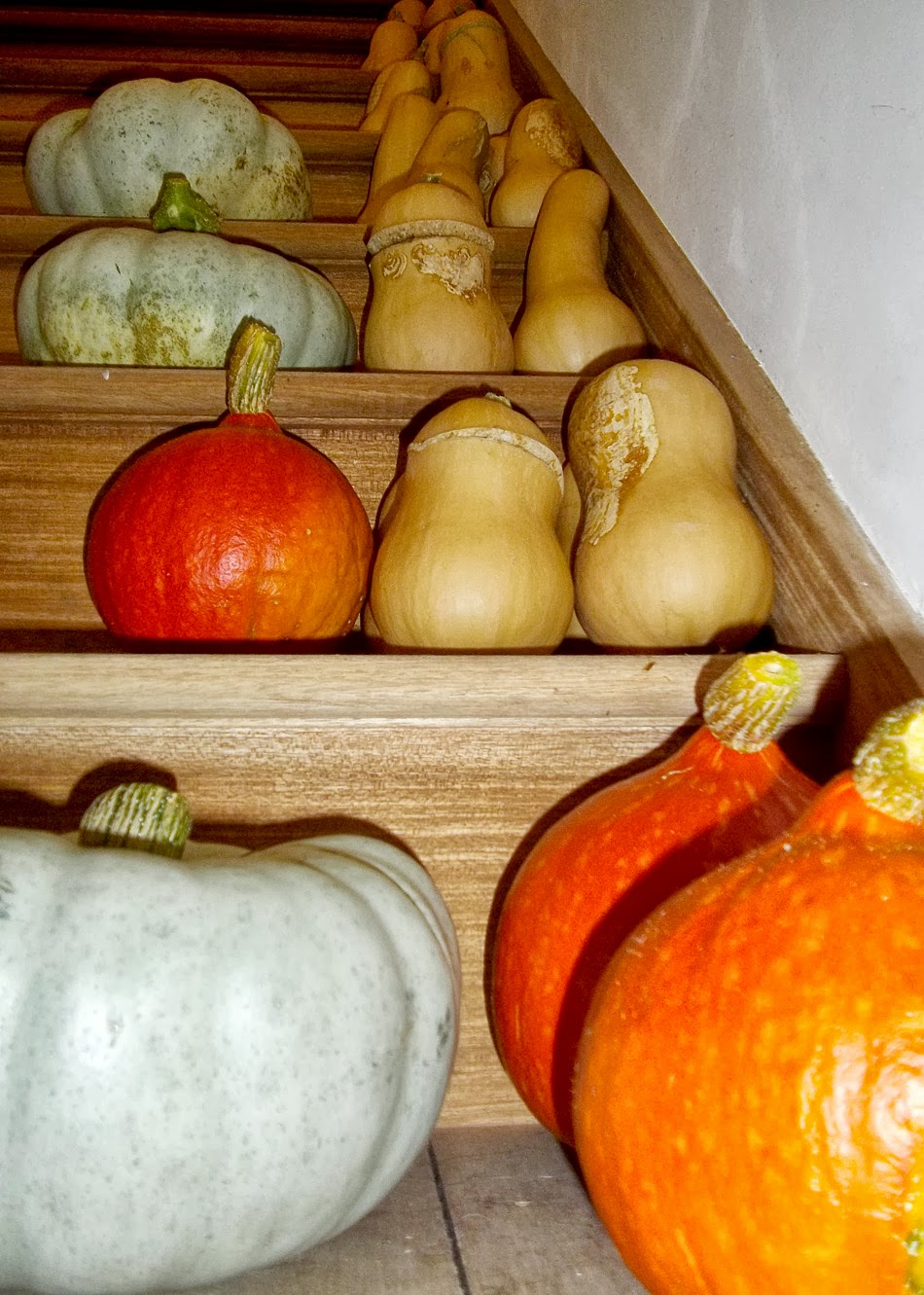
Some of my 2014 seed order has come from the Organic Gardening Catalogue. As a member of Garden Organic I get a 10% discount on my purchases. The bad news is that their advertised Crown Prince is actually a different F1 hybrid variety called Rarity. Some web searching indicates that Rarity produces smaller fruit (2 kilos instead of 3 to 4 - good) but that doesn't have so much flavour (bad). Compare the rounded smooth squashes in the picture below with the male flowers at top right to get an idea of the size, and with the lumpy, flattened, much bigger beasties on the stairs.

Rarity (the only picture I can find)
The OGC told me that their supplier maintained that Rarity is the same as Crown Prince, which clearly it isn't, though whether it is an improvement or not remains to be seen. They are reimbursing me, and I have ordered a replacement from King's Seeds (after telephoning them to make sure I wouldn't get Rarity again).

Spiced Pumpkin Ice cream
from Ices - the definitive guide by Caroline Liddell and Robin Weir
Ingredients
375ml / 12 fl oz milk
3 egg yolks
200g / 7 oz light brown sugar
½ tsp vanilla extract
pinch ground cloves
½ tsp ground ginger
¼ tsp ground nutmeg
¼ tsp ground pepper
250 ml / 8 fl oz thick pumpkin purée e.g steamed Crown Prince or Butternut
185ml / 6 fl oz whipping cream
2 tsp brandy
Makes about 1 litre / 32 fl oz.

Method
Make a custard with the milk, egg yolks, sugar and spices, by your favourite method - for example see here
Allow the custard to cool completely, stirring occasionally.
Beat in the pumpkin puree and the cream. Add the brandy, taste and add more spice if preferred.
Cover and chill it in the fridge. It can be left overnight at this stage, if necessary. Pass the mixture through a sieve to remove odd lumpy bits of pumpkin (if you’re fussy).
If using an ice cream maker, set it going and pour in the pumpkin mixture. Freeze to the consistency of softly whipped cream. Scrape into plastic boxes, cover with greaseproof or waxed paper and a lid, label and freeze.
If you don’t have an ice cream maker, follow the standard ‘still freezing’ technique.

Monday, 30 September 2013

Just a few pumpkins then...


Sunday 29th... Meteo60 promised us rain all day, more or less heavy.
After a dry, fairly overcast but not unpleasant morning with Pauline stringing onions in the hangar while Tim submitted the freezer to a long overdue triage and turned the results into a vast curry, a sudden decision was made to harvest the pumpkins.

Our method of growing pumpkins developed by accident on our allotment, when a long strip of ground that had held raspberries became overgrown. We cut down the growth and laid it along the strip, covering it with black polythene to help it rot down and prevent regrowth. Tim then added all the raked up strimmings from the three allotments we had [one was only fruit!]. Come next June we cut holes in the polythene to find a good layer of compost in which we planted the pumpkins - and other members of the family cucurbitae such as courgettes. They grew like billy-oh and produced a wonderful harvest. The polythene absorbs the sun's heat and keeps the roots warm, suppressing weeds at the same time. We learned quickly that we needed to mark the position of the planting holes with canes so we could water in the right place.

The 2012 "maggot" being planted up...
tomatoes were planted at the top end [through polythene]...
you can see the polythene and rocks at top left.
The pile of dry grass is to cover the maggot once planted.

This system has evolved into "the maggot", which is built during the summer mainly from mowings out of the orchard and potager areas. This is covered in spring with three large tarpaulins roped together and pinned down with rocks. The tarpaulins have hatches cut in them where the plants go. At planting time the holes are filled with a mixture of compost and sieved soil, dosed with pelleted chicken manure then in goes the plant, with a cane to mark its place. The tarpaulin is then covered in further mowings to protect it from the sun and to give the fruit something to rest on.


The "Maggot" about a month ago [August 25th]

Pumpkins need room to grow... the maggot is 14 metres by 3 metres...
the pale leaves near the top end are the Red Kuri...
it has sent one runner down as far as the Yellow Crookneck...

and back up as far as the melons which are right at the far end...
a total length of around 20 metres!
The Crown Prince [the large dark leaves at the top end]...
has completely covered the nine square metre area between the Red Kuri and the Melons...
and had to be guided back on to the maggot almost daily!!

Viewed from the "Melon End"... the gap between the Crown Prince and the melons closed within a week.
The maggot base for next year is visible to the right...  all the dead cucurbit plants, the hay over the tarps...
and anything still uncomposted under the current maggot will be added to next years!
This year's empty maggot bed will become 2014's Spud & Tomato bed.


This year the plantings were:
     Grown from seed:
Pumpkin [potiron] Crown Prince: 1 plant
Butternut Harrier: 3
Butternut Hunter: 3
Cucumber Diva: 1
Cucumber Marketmore: 1
Courgette Rond de Nice: 1
Squash Yellow Crookneck: 3 (one died)
     Bought in:
Red onion [pottimarron] squash Uchiki Kuri: 1 plant
Courgette Iceball: 1
Melon Cézanne :2 [in one pot]
Melon Troubadour: 2 [in one pot]
Pumpkin Blue Ballet: 1 (died)
Patidou: 1 (nearly died)
We have been harvesting cucumbers, courgettes and crooknecks all summer, and blogged about them here and here. Iceball is an excellent courgette, very like Rond de Nice but paler, earlier and more productive. The melons didn't really get going until late August, Troubadour being earlier, richer in flavour and producing more fruit.

The Patidou struggled but survived to produce two fruit, still immature so we left them a little longer. I am now certain Patidous are what I have tried growing in the past without much success: Sweet Dumpling. It has a creamy skin with dark green stripes - very attractive.

Sweet Dumpling... the dark green stripes turn a rich orange when fully mature.
[Note the fertile baby Hunter butternut at the bottom left!!]
The Crown Prince excelled itself, producing no less than 8 fruits with a combined weight just over 28 kilos. The root looked like the claw of a monstrous bird, possibly a roc.

It really had its claw in!
There was some speculation over what would have resulted had we restricted the plant to one fruit - a pumpkin we couldn't lift?

The Red Kuri produced almost as big a plant, but only three fruit, averaging at a kilo and a half. The fruits are indeed onion-shaped, deep orange flecked with cream. This Japanese derivative of the French potimarron is not a keeper, but has a rich chestnutty flavour. When we have grown it before, it was the earliest to ripen, but not this one. [Small ones work wonderfully for individual Hoofearnlywhittingstall Pumpkin Soup]

The first barrow load....
all the Red Kuris, the biggest Crown Prince...
and the split butternuts [mainly Harriers]


The other seven Crown Princes

The second barrow with the other Butternuts... mainly Hunter.

So far we have harvested 16 fruits from each of the two varieties of Butternut squash, a total of 27 kilos in weight. Hunter and Harrier are part of a series developed for growing in British conditions and named after military aircraft  (yes, Hawk and Hercules as well). There is no difference that I can discern between the two varieties, neither in appearance, size, flavour or keeping quality. However the Hunters have gone bonkers and produced a second flush of fruits which are swelling nicely - normally, late fruits get rejected and rot off. It's as though the plants have decided that their first flush is ripe and they have time and energy to have another go.
You might guess that we love Butternut squash!


So... now we have a stairwell full of pumpkins!!
AGAIN!!!