Showing posts with label squash. Show all posts

Tuesday, 2 September 2014

So what is the "maggot"?

The "maggot" was invented in the 2007 growing season on our allotment plot in Leeds. The previous summer, a row of raspberry plants reached the end of its working life. We were faced with a ten yard by one yard* area of couch grass, dandelions and old raspberry canes. Allotment associations have rules about weeds. Not having a great deal of time to spend weeding this strip, we covered it in heavy-duty black polythene and used it as a dump compost heap for grass clippings and other compostables. It was left for the requisite two seasons, with the addition of further layers of compostables, and then we lifted the polythene. Underneath, the annual weeds were gone, and the couch roots readily pulled out of the moist earth. We piled the decayed compost onto this surface and put the black polythene back to stop the weeds from taking hold again before we had worked out what to do with this new piece of ground.

The name "the maggot" came about from the shape formed by the wheelbarrow-loads of grass trimings and weeds, which created a series of mounds like a big green caterpillar. When Tim felt the heat radiating out of the long black cushion-like area that resulted, it seemed an ideal place to grow squashes and pumpkins. The black covering would keep the roots warm and retain moisture, the decaying vegetation would generate heat and nutrients, the living foliage would disguise the black polythene. We cut holes in the polythene, parted the compost to reach the soil surface, dug some pelleted chicken manure into the ground, added some general purpose compost, planted just four plants (Acorn squash, Crown Prince, Red Kuri, butternut Harrier...).
The pumpkins loved it. They grew phenomenally, and covered the black polythene completely. We quickly learned that we needed to mark the planting holes with canes, so that we could tell where to direct water and feed, so well hidden they were by leaves. The crop was excellent. We repeated the exercise the following year, in the same place, with equal success.

In France, the maggot system is used for all our cucurbitaceae - courgettes, cucumbers and melons as well as squashes and pumpkins. Every year it hs been refined slightly.In 2011 we replaced 2/3rds of the black polythene with tarpaulins (bâches), cutting the planting holes with a soldering iron to seal the edges. Last year we bought a third, which has two holes in for the pumpkins. Now there is a drip watering system, and we have retired the marker canes.
However, next year the canes will go back, to mark the plants for feeding, but we can't see the holes. We can't find them in the foliage!
A jetwash-type dispenser attaches to the ordinary hose for the feeds.

 
The maggot 2014 showing planting windows and scientific method of holding it down.

We use the maggot as a way of breaking in new land. We cycle our plantings through a series of five sets of beds. The 2014 maggot completes the cycle. Next year it moves to bed Number Two and will, hopefully, start to really condition the soil by adding all that composted vegetation to the soil for the start of 2016.
The pale green bâche in the background covers a stock of dry grass clippings that should have gone onto the maggot before the plants got too large. Unfortunately, the plants grew so quickly this year, we missed the opportunity, so it will be added to next year's "maggot".Or used to put around plants that need protection over the winter, then added to the compost cycle.

19/5/2014 Maggot ready for planting, the potato beds (site of 2013 maggot), leeks and onions (maggot 2012).
The planting windows are filled with a mixture of soil (originally molehills), fumier (bagged horse/cattle manure) and multipurpose compost, with added pelleted chicken manure and hoof and horn (corne broyée). The ground underneath is loosened with a fork so the roots can penetrate more easily. We raise our young plants in propagators in the guest room. They are moved into pots in a cold frame, and we plant them after the Ice Saints indicate the last frost is past.

25/07/2014 Growing strongly
Near row: from left, melons, Crown Prince, Sweet Dumpling (patidou), Red Kuri (potimarron), butternuts Harrier and Hunter, cucumber La Diva. Far row: Golden Nugget, courgette Rond de Nice, two plants each courgettes Précoce Maraichère and Ice Ball, Yellow Crookneck squash, cucumber Marketmore, another Yellow Crookneck.

25/7/2014 view from the Melon Patch showing the drip watering system
The dry grass is to lift the growing fruit away from the tarpaulin, which can collect rainwater in puddles.

30/08/2014 a breaking wave of vegetation - Sweet Dumpling heading to take over the melon patch
By the end of August the tarpaulins are completely covered and the vines are heading over the grass. The plants on the side near the wheelbarrow have put on so much greenery that we suspect there may be organic remains underneath dating back to the dairying days of our land. We may find out more next year when it comes to potato planting season.

The maggot, with Bezuard farm in the background

A hint of fruits to come:

Crown Prince

Red Kuri

Another Red Kuri, with a Butternut behind it

Sweet Dumpling / Patidou

* when Burley Model Allotments were established in 1958 on a site that was designated originally for allotments in 1892, a standard plot was 10 yards wide by 30 yards deep, an area, my dad used to say, of "one perch". A square perch is actually 30 ¼ square yards. No doubt the plot size is now 9.144 metres by 27.432 metres. No amount of metrication will make the plots any bigger or smaller.

Thursday, 16 January 2014

Turmeric - flavour of the month

At last I have been given the go-ahead to make one of my favourite chutneys - Squashney (Squash Chutney).
This spicy condiment is loosely based on a recipe for Marrow Chutney from Tim's 1971 Cordon Bleu "Preserving" by Rosemary Hume and Muriel Downes. Given our love for all things courge we had rather a large stock going back ten years, hence the embargo on producing any more.

The excuse this time was that we found some fresh turmeric at the All-green Pea.

Fresh turmeric from Biocoop, Châtellerault

Turmeric (curcuma in French) is the dried and ground root of a member of the Ginger family (Zingiberaceae), the main species being Curcuma longa. It is native to India but is grown all over Asia, and in Peru which is where ours came from. The fresh roots are long and narrow, taking the form of "hands" like ginger, with pinkish slightly knobbly skin.

All sorts of claims are currently being made about the health benefits of turmeric - that it can prevent cancer, heart attack, Parkinson's disease, Alzheimer's... control type 2 diabetes and weight loss... treat stomach ulcers, skin rashes, arthritis, leprosy, you name it, you can treat it with turmeric.  Just take two tablespoons a day and you'll live forever! You may have to put up with bright yellow pee, but you'll be able to wrestle gorillas. See an example of a slightly less excitable medical opinion here. Turmeric is actually useful for the treatment of dyspepsia and has been shown to be a painkiller as effective as ibuprofen for sufferers of osteoarthritis.

Be that as it may, the widest use of turmeric is for flavouring food. Turmeric is one of the staple spices of Asian, Caribbean and North African cooking. Known in India as Haldi, it is included in the diet because it is, as Madhur Jaffrey puts it, "a digestive and an antiseptic". It is also used to give a warm yellow colour (E100) to cheese, yoghurt, margarine and so on. As a fabric dye it gives a glorious but transient egg-yolk yellow, as I once discovered on the way home with a takeaway on my lap in a foil box with a hole in it that leaked curry sauce all over my shirt. My Ugandan Asian friend advised me to hang the shirt on the washline in the sun - in an afternoon it was as though the stain had never been.

Tim is determined to try growing some of the turmeric roots, given our success with growing ginger (zilch). We do not lack advice (here, here, here and here), although the advice is about as consistent as that of our old allotmenting friends on the subject of growing potatoes. If our plant (a) comes up (b) fails to die on us (c) undergoes some sort of miraculous conversion, it may even have an attractive flower, which is also edible.

Curcuma longa flowers, from www.decodedscience.com
We have fond memories of Squashney. One lunchtime we gave a jar of it to our friends the kitchen staff at the West Riding Refreshment Rooms in Dewsbury. On returning later in the afternoon we were presented with an empty jar and a request for more please! They had rapidly progressed from eating it spread on bread to scoffing it direct from the jar with a spoon.

Here's the recipe for Squash Chutney. You can use any kind of thick-fleshed squash or pumpkin. Acorn squash such as Table Ace are particularly good. Don't peel Acorn squash if they are fairly fresh - the colour contrast adds visual interest to the chutney. This time I used butternut squash, which I had to peel because the skin is quite hard. This quantity fills 5-6 standard jamjars.

Ingredients
4lb /2kg Squash
2 tbsp Salt
8oz / 250g pickling onions or shallots, peeled
½oz / 15g ground turmeric, or 1½oz / 45g fresh turmeric, peeled and chopped
9 chillies, fresh, frozen or pickled, coarsely chopped (use fewer if they are hot)
1½ oz / 45g ground ginger
1½ oz / 45g English mustard powder
1½lb. / 750g sugar
2 pints / 1½ l white malt, white wine or cider vinegar

Method
Remove seeds from the squash and peel them. Cut into ½ inch / 1cm cubes, place in a bowl and sprinkle with salt. Cover and leave overnight. Drain off the liquid.

Put remaining ingredients in a preserving pan. Heat gently to dissolve the sugar, then boil for 10 minutes. Add the squash and boil for about 40 minutes, or until tender and the liquid has thickened. If the mixture is still liquid, fish out the vegetables with a slotted spoon and boil the liquid until thick. Warning: do not over-boil or it turns into toffee.

Squashney with whole dried chillies - didn't work, replaced with chopped pickled Cayenne (volcanic)

Put into hot jars and screw down while still hot to make a good seal.

Serve with cheese, cold meats, sausages, curries or spread on crackers. Or even straight out of the jar.

Allow to mature for a couple of weeks. This should be ready at the beginning of February.

Tuesday, 26 November 2013

Crown Prince becoming a Rarity

The last of 2012's Crown Prince, unblemished and still perfectly edible, became Spiced Pumpkin Ice Cream at the end of October, 13 months after it was picked! See below for the recipe.

Banana Split with Spiced Pumpkin Ice Cream, Crème Crue and Marrons Glacées
The harvest at the end of September stimulated the Uchiki Kuri and the Butternuts into further action! The incredibly late autumn meant that we had to balance the fact that the fruit were still swelling against the preparedness of the slugs and snails to attack them.

The additions bring Uchiki Kuri to seven fruits averaging just over a kilo, and the two varieties of Butternut to 22 fruits apiece, averaging 750 grammes (Harrier) and 830 grammes (Hunter). Harrier's batting average was distorted by the last two fruit, at 182 grammes apiece. The plants averaged seven fruits each, which is not bad at all. We have a total of 71 kilos of pumpkin and winter squash, 61 fruits altogether.

From the top - Uchiki Kuri, Sweet Dumpling, Crown Prince and Pomme d'Or from Tournon Fête aux Arbres

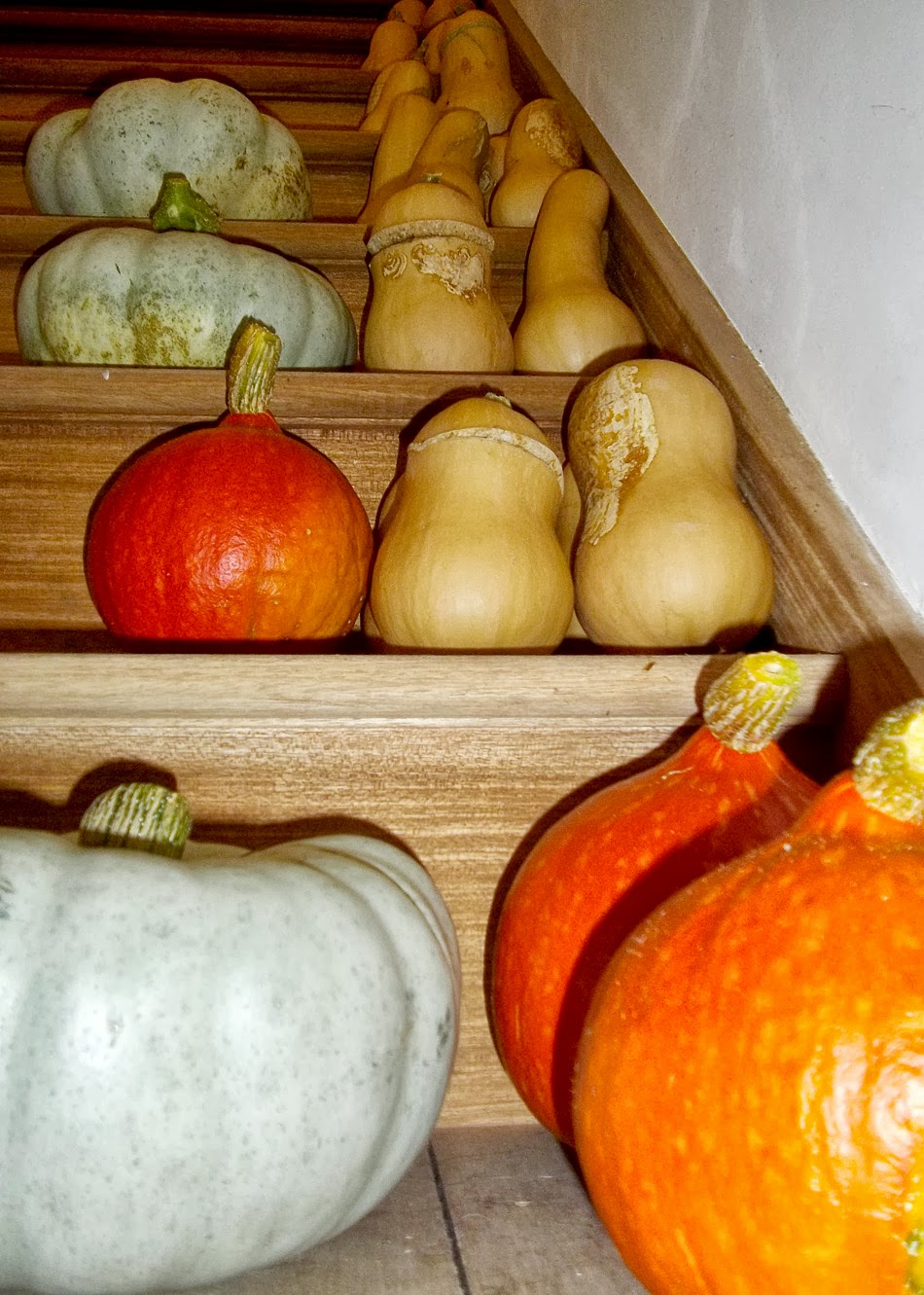
Some of my 2014 seed order has come from the Organic Gardening Catalogue. As a member of Garden Organic I get a 10% discount on my purchases. The bad news is that their advertised Crown Prince is actually a different F1 hybrid variety called Rarity. Some web searching indicates that Rarity produces smaller fruit (2 kilos instead of 3 to 4 - good) but that doesn't have so much flavour (bad). Compare the rounded smooth squashes in the picture below with the male flowers at top right to get an idea of the size, and with the lumpy, flattened, much bigger beasties on the stairs.

Rarity (the only picture I can find)
The OGC told me that their supplier maintained that Rarity is the same as Crown Prince, which clearly it isn't, though whether it is an improvement or not remains to be seen. They are reimbursing me, and I have ordered a replacement from King's Seeds (after telephoning them to make sure I wouldn't get Rarity again).

Spiced Pumpkin Ice cream
from Ices - the definitive guide by Caroline Liddell and Robin Weir
Ingredients
375ml / 12 fl oz milk
3 egg yolks
200g / 7 oz light brown sugar
½ tsp vanilla extract
pinch ground cloves
½ tsp ground ginger
¼ tsp ground nutmeg
¼ tsp ground pepper
250 ml / 8 fl oz thick pumpkin purée e.g steamed Crown Prince or Butternut
185ml / 6 fl oz whipping cream
2 tsp brandy
Makes about 1 litre / 32 fl oz.

Method
Make a custard with the milk, egg yolks, sugar and spices, by your favourite method - for example see here
Allow the custard to cool completely, stirring occasionally.
Beat in the pumpkin puree and the cream. Add the brandy, taste and add more spice if preferred.
Cover and chill it in the fridge. It can be left overnight at this stage, if necessary. Pass the mixture through a sieve to remove odd lumpy bits of pumpkin (if you’re fussy).
If using an ice cream maker, set it going and pour in the pumpkin mixture. Freeze to the consistency of softly whipped cream. Scrape into plastic boxes, cover with greaseproof or waxed paper and a lid, label and freeze.
If you don’t have an ice cream maker, follow the standard ‘still freezing’ technique.

Monday, 30 September 2013

Just a few pumpkins then...


Sunday 29th... Meteo60 promised us rain all day, more or less heavy.
After a dry, fairly overcast but not unpleasant morning with Pauline stringing onions in the hangar while Tim submitted the freezer to a long overdue triage and turned the results into a vast curry, a sudden decision was made to harvest the pumpkins.

Our method of growing pumpkins developed by accident on our allotment, when a long strip of ground that had held raspberries became overgrown. We cut down the growth and laid it along the strip, covering it with black polythene to help it rot down and prevent regrowth. Tim then added all the raked up strimmings from the three allotments we had [one was only fruit!]. Come next June we cut holes in the polythene to find a good layer of compost in which we planted the pumpkins - and other members of the family cucurbitae such as courgettes. They grew like billy-oh and produced a wonderful harvest. The polythene absorbs the sun's heat and keeps the roots warm, suppressing weeds at the same time. We learned quickly that we needed to mark the position of the planting holes with canes so we could water in the right place.

The 2012 "maggot" being planted up...
tomatoes were planted at the top end [through polythene]...
you can see the polythene and rocks at top left.
The pile of dry grass is to cover the maggot once planted.

This system has evolved into "the maggot", which is built during the summer mainly from mowings out of the orchard and potager areas. This is covered in spring with three large tarpaulins roped together and pinned down with rocks. The tarpaulins have hatches cut in them where the plants go. At planting time the holes are filled with a mixture of compost and sieved soil, dosed with pelleted chicken manure then in goes the plant, with a cane to mark its place. The tarpaulin is then covered in further mowings to protect it from the sun and to give the fruit something to rest on.


The "Maggot" about a month ago [August 25th]

Pumpkins need room to grow... the maggot is 14 metres by 3 metres...
the pale leaves near the top end are the Red Kuri...
it has sent one runner down as far as the Yellow Crookneck...

and back up as far as the melons which are right at the far end...
a total length of around 20 metres!
The Crown Prince [the large dark leaves at the top end]...
has completely covered the nine square metre area between the Red Kuri and the Melons...
and had to be guided back on to the maggot almost daily!!

Viewed from the "Melon End"... the gap between the Crown Prince and the melons closed within a week.
The maggot base for next year is visible to the right...  all the dead cucurbit plants, the hay over the tarps...
and anything still uncomposted under the current maggot will be added to next years!
This year's empty maggot bed will become 2014's Spud & Tomato bed.


This year the plantings were:
     Grown from seed:
Pumpkin [potiron] Crown Prince: 1 plant
Butternut Harrier: 3
Butternut Hunter: 3
Cucumber Diva: 1
Cucumber Marketmore: 1
Courgette Rond de Nice: 1
Squash Yellow Crookneck: 3 (one died)
     Bought in:
Red onion [pottimarron] squash Uchiki Kuri: 1 plant
Courgette Iceball: 1
Melon Cézanne :2 [in one pot]
Melon Troubadour: 2 [in one pot]
Pumpkin Blue Ballet: 1 (died)
Patidou: 1 (nearly died)
We have been harvesting cucumbers, courgettes and crooknecks all summer, and blogged about them here and here. Iceball is an excellent courgette, very like Rond de Nice but paler, earlier and more productive. The melons didn't really get going until late August, Troubadour being earlier, richer in flavour and producing more fruit.

The Patidou struggled but survived to produce two fruit, still immature so we left them a little longer. I am now certain Patidous are what I have tried growing in the past without much success: Sweet Dumpling. It has a creamy skin with dark green stripes - very attractive.

Sweet Dumpling... the dark green stripes turn a rich orange when fully mature.
[Note the fertile baby Hunter butternut at the bottom left!!]
The Crown Prince excelled itself, producing no less than 8 fruits with a combined weight just over 28 kilos. The root looked like the claw of a monstrous bird, possibly a roc.

It really had its claw in!
There was some speculation over what would have resulted had we restricted the plant to one fruit - a pumpkin we couldn't lift?

The Red Kuri produced almost as big a plant, but only three fruit, averaging at a kilo and a half. The fruits are indeed onion-shaped, deep orange flecked with cream. This Japanese derivative of the French potimarron is not a keeper, but has a rich chestnutty flavour. When we have grown it before, it was the earliest to ripen, but not this one. [Small ones work wonderfully for individual Hoofearnlywhittingstall Pumpkin Soup]

The first barrow load....
all the Red Kuris, the biggest Crown Prince...
and the split butternuts [mainly Harriers]


The other seven Crown Princes

The second barrow with the other Butternuts... mainly Hunter.

So far we have harvested 16 fruits from each of the two varieties of Butternut squash, a total of 27 kilos in weight. Hunter and Harrier are part of a series developed for growing in British conditions and named after military aircraft  (yes, Hawk and Hercules as well). There is no difference that I can discern between the two varieties, neither in appearance, size, flavour or keeping quality. However the Hunters have gone bonkers and produced a second flush of fruits which are swelling nicely - normally, late fruits get rejected and rot off. It's as though the plants have decided that their first flush is ripe and they have time and energy to have another go.
You might guess that we love Butternut squash!


So... now we have a stairwell full of pumpkins!!
AGAIN!!!

Thursday, 12 September 2013

A Pain in the Crookneck

For the second year running we have grown Yellow Crooknecks....
they have rapidly become a  favourite.
We had three plants to start with...
one didn't thrive and eventually went to the "great composter in the corner"....
but the other two grew well...
very well...
very well indeedy!!
They are...
HUGE!!

The crooknecks are the two, huge, dark green plants...The gap on the right is where the third was!

They are triffid-like...

And underneath those leaves the triffid hides its mouth....
with droopy yellow tentacles...
and I'm beginning to dream about the things!
Rank upon rank of marching, yellow, gooselike gourds!!


We have used Yellow Crookneck instead of courgette in any dish that will take it...
and in many, many others.
We aren't going yellow through jaundice...
it's them thar crooknecks*!!!

Not more Crooknecks!!!!..... please!


Not that I am complaining....
oh no!
Crooknecks are creamier and more dense in the flesh than a courgette...
slightly sweeter, too...
so we started using them as a courgette substitute because our real ones were very late.

They are great sliced and fried...
they are nice raw with mayo...
they are wonderful in a courgette and tomato soup...
which, as Pauline decided to use Lemon Boy tomatoes...

A Yellow Crookneck squash with a Lemon Boy tomato.

was an all yellow affair... quite a visual/taste experience...
and great cold, too!!

A large pan full of chunky yellow soup!

And this serving for one barely dented the surface...

Pauline also made a yellow Ratatouille for bottling...

Ratatouille using Yellow Crookneck

and a very yellow version of a marrow mustard pickle...
That looks wonderful in the bottle... all glowing!!


Yellow Crookneck Mustard Pickle

Then Ken posted a Stuffed Courgette Boat recipe...
right... another use...
so we did a version using the crooknecks...

Cheese stuffed Yellow Crookneck....

and that will be repeated, too!!

Stuffed Yellow Crookneck served with fresh "Moonlight" Runner Beans and new "Charlotte" spuds.


Fortunately...
very fortunately...
we have this book...

"What will I do with all those Courgettes?" by Elaine Borish

...and all the recipes work with Crooknecks!!

*And possibly all the Lemon Boys...
we seem to have a yellow theme going this year....